Dental Bridges
A bridge fills the gap left by one or more missing teeth, anchored to the healthy teeth on either side. It keeps your remaining teeth from drifting out of position, and it looks natural enough that most people will never know it is there.
How a bridge works
About dental bridges
Dental bridges in Northridge, CA
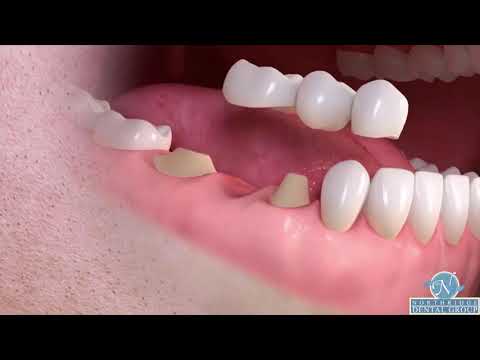
A bridge replaces one or more missing teeth. It is made of abutments, which attach to the healthy teeth on either side of the gap, and a false tooth or teeth in between called pontics. Most bridges are fixed, meaning they are cemented in place and cannot be removed the way a partial denture can.
In areas of the mouth under less chewing stress, such as the front teeth, a cantilever or Maryland bridge may be used instead. These are minimally invasive and preserve more of the neighboring teeth, but they do carry a higher risk of failure, so we will tell you honestly whether one suits your case.
Who a bridge helps
Any patient missing a tooth or several teeth in a row could meaningfully improve their quality of life with a bridge. It restores your ability to chew properly, and it looks natural enough that you can smile and speak without thinking about it.
Why replacing a missing tooth matters
Many patients feel self-conscious about a visible gap, but the bigger issue is what happens underneath. The teeth surrounding the gap will gradually shift to fill the space. That causes problems with spacing and alignment, and it can loosen otherwise healthy teeth to the point where they are eventually lost too.
Shifting and loose teeth are harder to chew with and considerably more prone to decay and infection. A bridge fills the gap so your remaining teeth stay where they belong and stay healthy.
What a bridge asks of you
The average life of a bridge is about ten years, similar to a crown, and it can last years longer with proper care. It does require a real commitment to oral hygiene and regular cleanings, because the anchor teeth are carrying the whole restoration. We would rather tell you that upfront than have it come as a surprise.
Bridges are one of several options in our restorative dentistry care. Depending on your situation, an implant or a partial denture may suit you better, and we are happy to go through the tradeoffs of each.
Dental bridges in Northridge, CA
A bridge replaces one or more missing teeth. It is made of abutments, which attach to the healthy teeth on either side of the gap, and a false tooth or teeth in between called pontics. Most bridges are fixed, meaning they are cemented in place and cannot be removed the way a partial denture can.
In areas of the mouth under less chewing stress, such as the front teeth, a cantilever or Maryland bridge may be used instead. These are minimally invasive and preserve more of the neighboring teeth, but they do carry a higher risk of failure, so we will tell you honestly whether one suits your case.
Who a bridge helps
Any patient missing a tooth or several teeth in a row could meaningfully improve their quality of life with a bridge. It restores your ability to chew properly, and it looks natural enough that you can smile and speak without thinking about it.
Why replacing a missing tooth matters
Many patients feel self-conscious about a visible gap, but the bigger issue is what happens underneath. The teeth surrounding the gap will gradually shift to fill the space. That causes problems with spacing and alignment, and it can loosen otherwise healthy teeth to the point where they are eventually lost too.
Shifting and loose teeth are harder to chew with and considerably more prone to decay and infection. A bridge fills the gap so your remaining teeth stay where they belong and stay healthy.
What a bridge asks of you
The average life of a bridge is about ten years, similar to a crown, and it can last years longer with proper care. It does require a real commitment to oral hygiene and regular cleanings, because the anchor teeth are carrying the whole restoration. We would rather tell you that upfront than have it come as a surprise.
Bridges are one of several options in our restorative dentistry care. Depending on your situation, an implant or a partial denture may suit you better, and we are happy to go through the tradeoffs of each.
Find out what is actually going on
Schedule an exam and get a clear, honest picture of your oral health.